


India has one of the largest fast-moving consumer goods markets in the world, and the companies that have built real scale here have done so over decades, not overnight. The FMCG sector spans food and beverages, personal care, household products, tobacco, dairy, and confectionery, and the companies at the top of that landscape are the ones that have learned to operate across very different consumer segments at once. That kind of breadth takes time to build, which is why the names at the top of this list tend to have long histories behind them.
What Scale Actually Means in the Indian FMCG Context
India isn’t a single market in any meaningful sense. Consumer preferences in Tamil Nadu differ markedly from those in Punjab or Assam, and price sensitivity across income levels adds another layer of complexity. The FMCG companies in India that have achieved genuine national scale are the ones that have built distribution networks capable of moving between urban modern trade and deep rural markets without losing efficiency in either. That last-mile reach takes years to build and is genuinely hard to replicate.
Manufacturing footprint matters too, though it gets less attention than brand recognition. A company running multiple production facilities across different states has structural advantages in supply chain resilience, regional compliance, and the ability to respond quickly to demand shifts in specific geographies. It also signals a level of capital commitment that separates the major players from companies that outsource most of their production.
The Leading Players, by the Numbers
Hindustan Unilever (HUL) is generally regarded as India’s largest FMCG company by market capitalisation, with a market cap north of ₹5 lakh crore. Established in 1933, it manages more than 50 brands across 16 categories, including Dove, Surf Excel, Lifebuoy, Lux, and Horlicks, giving it dominance across personal care, home care, and packaged food simultaneously.
ITC Limited, founded in 1910, began as a tobacco company and has since built one of the country’s most diversified FMCG portfolios, with brands like Aashirvaad, Sunfeast, Bingo!, Fiama, and Vivel sitting alongside its hospitality, paperboards, and agri-business interests. Its market capitalisation has been reported in the ₹4-5.8 lakh crore range depending on the period measured.
Nestlé India, a subsidiary of Nestlé SA, runs eight manufacturing facilities in the country and carries a market cap of roughly ₹2 lakh crore. Maggi remains its most recognisable brand, alongside Nescafé and KitKat, and its packaged food dominance comes from consistent formulation quality across a fairly narrow but deep category range.
How Brand Portfolio Depth Defines the Major Players
The brand portfolio of a major FMCG company tells a more complete story than its revenue figures in isolation. A company with strong brands across food, beverages, and impulse-purchase categories has a fundamentally different market presence from one that dominates a single category. Different categories carry different seasonal patterns, margin structures, and loyalty dynamics, so spreading across them gives a kind of stability single-category players can’t match, which is exactly why HUL and ITC, despite competing in overlapping categories, are rarely displaced from the top of these lists.
Among top-tier FMCG companies, the most durable positions tend to belong to those with at least one brand that has become genuinely category-defining, where consumers use the brand name as shorthand for the product type itself. That level of recognition takes consistent product quality and distribution over a very long period to build, and it tends to be self-reinforcing, since retailers prioritise shelf space for products they already know consumers will ask for.
Where DS Group Fits
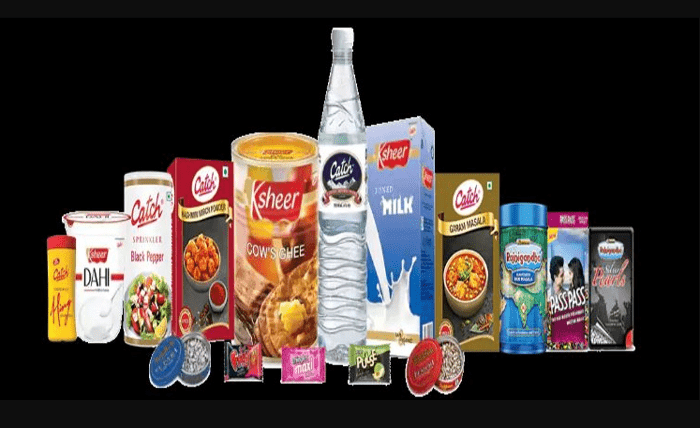
DS Group (Dharampal Satyapal Group), founded in 1929 and headquartered in Noida, is a useful example of a professionally managed conglomerate that has diversified well beyond its legacy tobacco business, which now accounts for less than 10% of group turnover, down from decades of being its core revenue driver. The group runs over 50 manufacturing sites (including partner and third-party facilities) and operates across food and beverages, confectionery, mouth fresheners, dairy, hospitality, and agribusiness.
Its brand portfolio reflects that spread. In confectionery and mouth fresheners, it holds Catch Spices, Rajnigandha, Pass Pass, and Pulse Candy, brands with genuine category recognition in their own right. In food and beverages specifically, the portfolio includes LuvIt (chocolates and confectionery), and the dairy brands Ksheer and Ovino, alongside its hospitality arm under Namah and Manu Maharani. That range, spanning a legacy mouth-freshener business, a modern confectionery push, and a growing dairy and hospitality footprint, is what makes DS Group worth including in this conversation rather than treating it as a single-category player: it has built the same kind of category breadth that defines the larger listed FMCG names, just under private ownership and with less public financial disclosure.
What This Comparison Shows
Looking at manufacturing footprint, market capitalisation, category range, and brand recognition together gives a far more complete picture of scale than any single metric. HUL and ITC lead on breadth and market value; Nestlé and Britannia lead on category depth within packaged food; Dabur and DS Group show how legacy, heritage-driven companies can rebuild themselves around new categories without losing what made their original brands trusted in the first place. The common thread across all of them is time, none of this scale was built quickly, and none of it is easily replicated by a new entrant, however well-funded.