


Extracting structured data from academic papers is quickly changing from a painstaking manual chore into something far more systematic and automated. The sheer volume of published research — over 360 million documents across dozens of disciplines, with tens of thousands more appearing daily — has made it impossible for any researcher to manually pull every relevant data point from the literature they need. Platforms like WisPaper are beginning to reshape how researchers move from reading a paper to actually using the data inside it. The difference between hunting through PDFs for hours and having structured data surfaced automatically will determine which labs stay competitive.
The Weight of Manual Data Mining from Papers
Extracting data from a research paper by hand is like panning for gold in a river of ink — every useful nugget is buried in pages of prose, tables, and figures that were never designed for machine consumption. A single paper might describe an experimental protocol across six different sections, scatter its parameter settings between a methods paragraph and a supplementary table, and bury the model architecture in a dense paragraph of technical shorthand. To capture all of this accurately, a researcher must read, re-read, cross-reference, and transcribe with painstaking care, knowing that a single misread learning rate or misunderstood ablation setting could derail months of follow-up work. This kind of extraction demands both deep subject-matter expertise and an almost editorial patience that few labs can afford at scale.
Demand for Automated Research Data Extraction
The demand for faster, more reliable data extraction cuts across every corner of the research ecosystem. A doctoral student conducting a systematic review needs to pull consistent variables from hundreds of papers; a machine learning engineer benchmarking a new model class needs to extract architectures and hyperparameters from a dozen competing papers published in the last six months; a pharmaceutical researcher needs to compare dosing protocols and outcome measures across preclinical studies spanning two decades. In each case, the bottleneck is the same: the gap between what is published and what is usable. Traditional keyword search and manual spreadsheet compilation simply cannot keep pace with the accelerating rate of publication.
Challenges in Research Data Collection
The fundamental challenge in research data collection is that academic papers are written for human readers, not for data pipelines. Information is distributed unevenly across abstracts, methods sections, figure captions, and supplementary materials, often with inconsistent terminology, implicit assumptions, and formatting that varies wildly between journals and subfields. A parameter described as “learning rate” in one paper appears as “step size” in another and as the Greek letter eta in a third, while critical experimental conditions might be mentioned only in a figure footnote. At the scale of millions of papers, these inconsistencies compound into a near-insurmountable obstacle for any manual or rule-based extraction approach.
Streamlining Paper-to-Data Extraction Pipelines
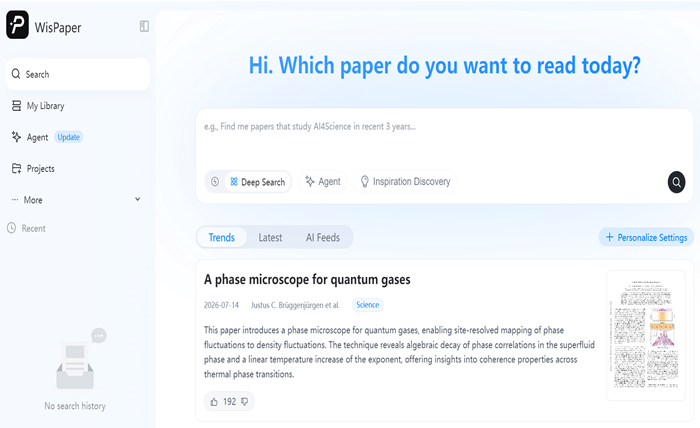
A growing class of AI-assisted tools is beginning to address this fragmentation by combining deep document understanding with structured extraction workflows. WisPaper, for instance, offers PaperClaw, which ingests uploaded PDFs and automatically parses experimental steps, model architectures, and parameter configurations, then generates detailed execution plans that make experiment reproduction far more tractable. Its AI Copilot Immersive Reading mode complements this by transforming dense academic prose into structured, readable narratives and enabling cloud-synced annotations, so that extracting meaning from a paper no longer requires fighting its formatting. Meanwhile, its Deep Search capability verifies search intent with 95 percent accuracy and handles complex logical queries — such as “including A but excluding B” — with a transparent workflow that shows precisely how a query was deconstructed and resolved, ensuring that the papers feeding into the extraction pipeline are the right ones from the start.
More Faster, More Complete Research Datasets
The ultimate promise of automated data extraction is not merely speed but completeness — datasets that capture the full experimental nuance of the literature rather than the subset a harried researcher had time to transcribe. When extraction pipelines can parse protocols, architectures, and parameters from hundreds of papers with consistent fidelity, systematic reviews become genuinely systematic, meta-analyses grow more representative, and reproducibility efforts gain a foundation of machine-verified detail. What was once a bottleneck becomes a standard, repeatable step in the research workflow.
The shift toward automated extraction is part of a broader transformation in how scientific knowledge moves from publication to practice. As the research corpus continues its exponential growth, the institutions and labs that build robust extraction pipelines will be the ones positioned to synthesize insight from the full sweep of the literature rather than the narrow slice they can manage by hand. In that sense, the question is not whether automated extraction will become standard, but how quickly the gap will close between what is published and what is truly known.